
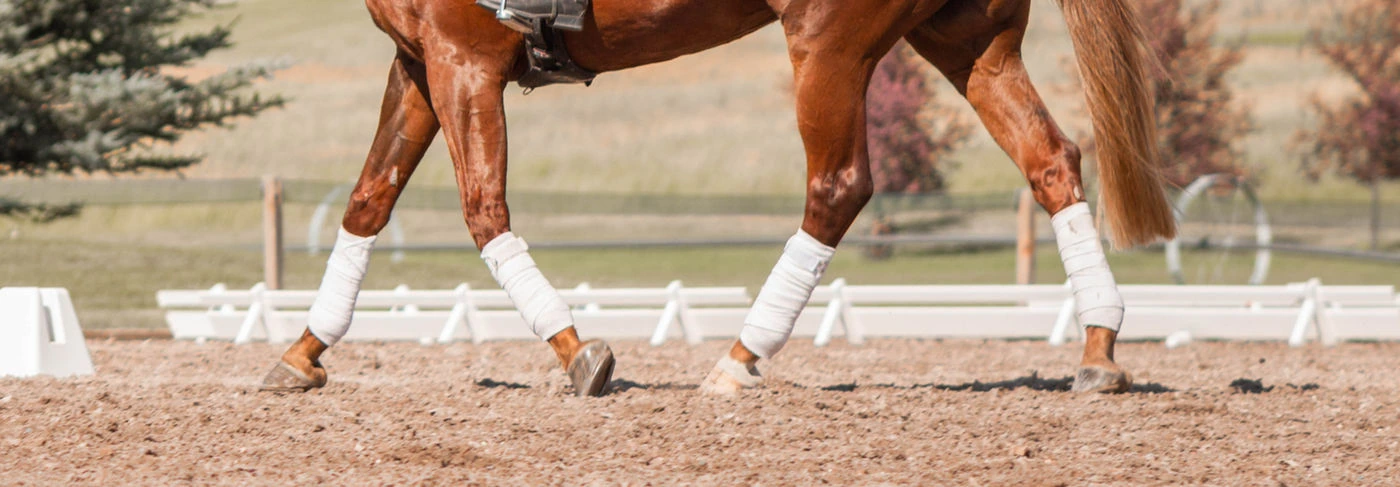
The walk, often overlooked due to its simplicity, is a fundamental gait in the equestrian world, essential for assessing a horse's potential across various disciplines. In this final installment of our series on the biomechanics of the walk, we focus on its significance in training and competition, and the common issues that can arise.
The walk's role in equestrian disciplines
Within the equestrian sphere, the walk is a critical component, particularly in dressage. Here, the walk is scrutinized for its rhythm, balance, and the horse’s ability to “track up.” In dressage, the walk holds equal weight to the trot and canter, and a horse’s capability at the walk can significantly influence its scores. Dressage judges look for a consistent four-beat rhythm, the correct placement of hooves, and the overall impression of athletic potential.
Variations of the walk in competition
In competitive dressage, the walk is showcased in four variations: free, extended, medium, and collected. Each variation tests different aspects of the horse’s training and natural ability:
- The free walk emphasizes relaxation and the horse’s natural stride.
- The extended walk lengthens the stride to cover maximum ground possible.
- The medium and collected walks focus on the horse’s ability to shorten its stride while maintaining rhythm and "tracking up."
Achieving these variations requires careful conditioning and an understanding of the biomechanics discussed in previous posts.
Identifying and correcting faults
Despite its foundational role, the walk can be compromised through training mishaps or physical limitations. Recognizing and addressing these faults is crucial for a horse’s development and performance:
- Hasty strides: A hurried walk can disrupt the natural four-beat rhythm, often a result of tension. Correction involves slowing the pace and encouraging forward movement into a relaxed hand.
- The Shuffle: Anticipation of a faster gait may lead to uncoordinated, rapid steps, particularly in less experienced horses. Proper relaxation and conditioning can alleviate this issue.
- Pacing: A lateral walk, where lateral pairs of legs move in unison, can be problematic. Resolving pacing requires determining whether to slow the front legs or quicken the hind legs, with regular half-halts to rebalance the horse.
Conformational considerations
A horse’s conformation can greatly influence its natural ability at the walk. Short-backed horses with longer legs generally find it easier to achieve an ideal walk, as their build facilitates tracking up. Conversely, long-backed horses with shorter legs may struggle to attain high scores in disciplines like dressage. However, it’s important to note that conformation is not the sole determinant of a horse’s walk quality.
The walk in endurance riding
Endurance riding is another discipline where the walk is highly valued. Endurance horses are required to cover long distances efficiently, and a strong walk allows them to conserve energy while maintaining a good pace.
Concluding the walk’s journey
Understanding the walk is a key aspect of equestrianism, both for the health of the horse and for achieving competitive excellence. The walk, in all its variations, tests the training, conditioning, and natural ability of the horse, providing a clear lens through which to view the animal's biomechanical soundness and potential. Careful training that respects the horse's natural biomechanics can enhance the walk, preventing injuries and ensuring that the horse's athletic capabilities are fully realized.
As we wrap up this series, remember that the walk, while fundamental, is a complex interplay of biomechanics and training. Respect for this gait's intricacies will not only improve performance but also contribute to the overall well-being of the horse.
Sources
- Clayton, H.M. The Dynamic Horse: A Biomechanical Guide to Equine Movement and Performance. Sport Horse Publications, 2004.
- Pilliner, Sarah, Samantha Elmhurst, and Zoe Davies. The Horse in Motion: The Anatomy and Physiology of Equine Locomotion. Wiley-Blackwell, 2002.
- Blignault, Karin. Equine Biomechanics for Riders: The Key to Balanced Riding. J. A. Allen, 2009.
- Back, Willem, and Hilary M. Clayton. Equine Locomotion. Saunders Ltd, 2013.
At Seven Hills Training in Monroe, WA, our biomechanics-based programs integrate classical principles with modern understanding to improve every stride—from foundational walk work to advanced collection. To learn how biomechanics-based training can enhance your horse’s rhythm, soundness, and performance, contact us.
Also see
Understanding Equine Biomechanics: The Key to Improved Performance
The Walk: An Introduction to Equine Biomechanics – Part 1
Back to all insights